
AI in ComplyTrain
An always-on compliance expert - that never signs off on its own
ComplyTrain's AI agents are senior subject-matter experts, trained by Skylen's compliance team, working inside a fully structured quality system. They do the heavy reading, drafting and checking. A named person always decides.
Everyone has AI now. The difference is what it is allowed to do.
Bolting a chatbot onto a compliance tool is easy, and it is not what a compliance team needs. What you need is different, and harder: an assistant that answers from your own approved procedures and records rather than the open internet, that drafts against the exact requirement a section has to satisfy, and that can never quietly change the quality system you will be audited on. That is how our AI is built - in the architecture, not the marketing.
Our agents behave like senior subject-matter experts. Briefed by our compliance team and given the standard in front of them, they work inside a system where every document, requirement and record has its place. They do the slow, careful work - reading across your material, drafting a section, checking a clause - and hand you something to decide on. One sentence holds true everywhere in the product: AI drafts and proposes; only a person approves.
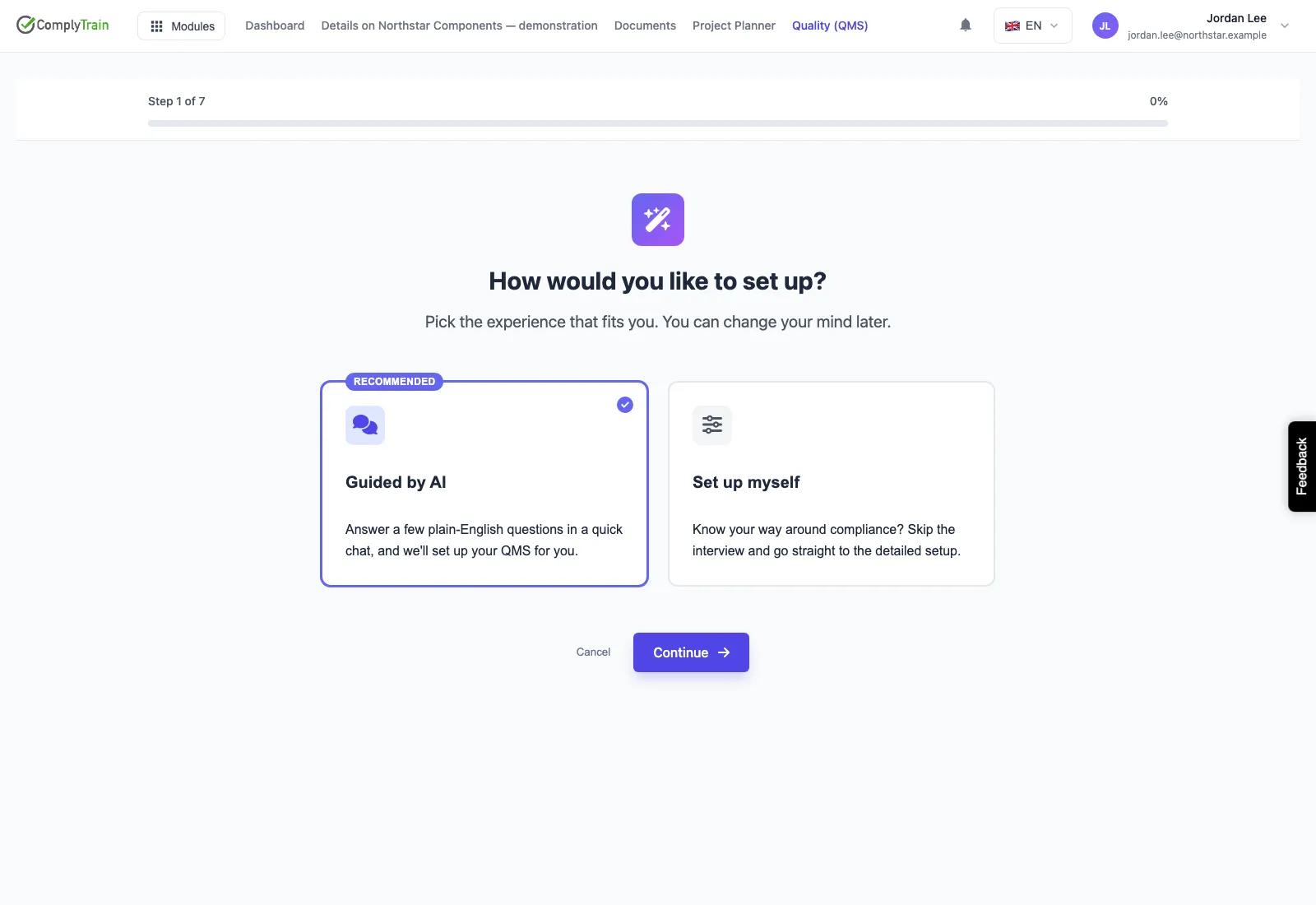
It asks first
You choose how much the AI does
Setting up a quality system opens with a real choice: let the agent guide the build, or configure it yourself. Both paths reach the same structure, and the guided one proposes rather than decides.
That is the shape of every AI action in the product. A proposal arrives with its reasoning, and a person accepts or rejects it. A controlled document still goes through its normal approval afterwards, so nothing an agent drafts becomes part of your quality system on its own.
- Guided or manual, with the same end structure
- Every proposal is accepted or rejected by a person
- Approval stays a human act, on the normal route
What makes it different
Capable enough to do the real work. Constrained enough to trust with a quality system.
It asks you the right questions
Our agents don't wait to be prompted. Your onboarding advisor already knows which facts a standard requires, checks what it has, and asks only for the gaps - one plain-English question at a time. The AI mock-audit interviewer does the same, playing a certification auditor and pressing your answers for evidence before the real thing.
Answers grounded in your own records
Ask 'which of our requirements touch leadership responsibilities?' and get an answer drawn from your approved procedures and records - not from general internet knowledge. And every agent can be spoken to as well as typed to, so you can ask out loud while your hands are on the work.
Drafts that already fit the standard
Because every section carries its purpose, the requirements it must satisfy and an expert template, the agent is never asked to 'just write'. It restructures what your organisation already knows into a section built for the clause it answers to.
Gaps are flagged, not filled
Where a detail is genuinely unknown, the agent is built to leave a clearly marked placeholder for you to complete rather than a plausible-sounding guess. Treat what it produces as a draft to be checked: nothing it writes becomes part of your quality system until a person has reviewed and accepted it.
Every change is yours to accept
AI edits arrive as tracked changes, with the reasoning behind each one, that you accept or reject individually. Nothing moves in your document until you say so, and each acceptance is recorded as its own version entry.
Locked the moment you approve
Only a person can approve a document. Once approved, it is locked against every edit - the AI's included, enforced beneath the surface so no automated tool can route around it. Every AI action stays attributed and reversible, so an auditor can always tell what the machine did from what a human decided.
How it works
It asks, it drafts, you decide
The same shape holds across onboarding, authoring and audit preparation: the agent does the work, and hands the decision to you.
It asks
Your advisor opens the conversation. It knows what the standard needs and what it already has about you, and asks only for the gaps - one question at a time, threaded to the people in your organisation who would actually know the answer.
It reads and drafts
Grounded in your own approved documents, the requirements each section must satisfy and an expert template, the agent drafts a section built for the clause - marking anything it genuinely does not know with a placeholder rather than a guess.
You review
Proposals land as tracked changes with the reasoning attached. Accept the ones that are right, reject the rest. Nothing changes in the document until you act, and every accepted change is recorded against your name.
You approve - and it holds
Approval is a human act, and can be held back until the approver has the training the document requires. The moment you approve, the document locks - against the AI too - and the record of exactly which requirements that version satisfies is frozen for good.
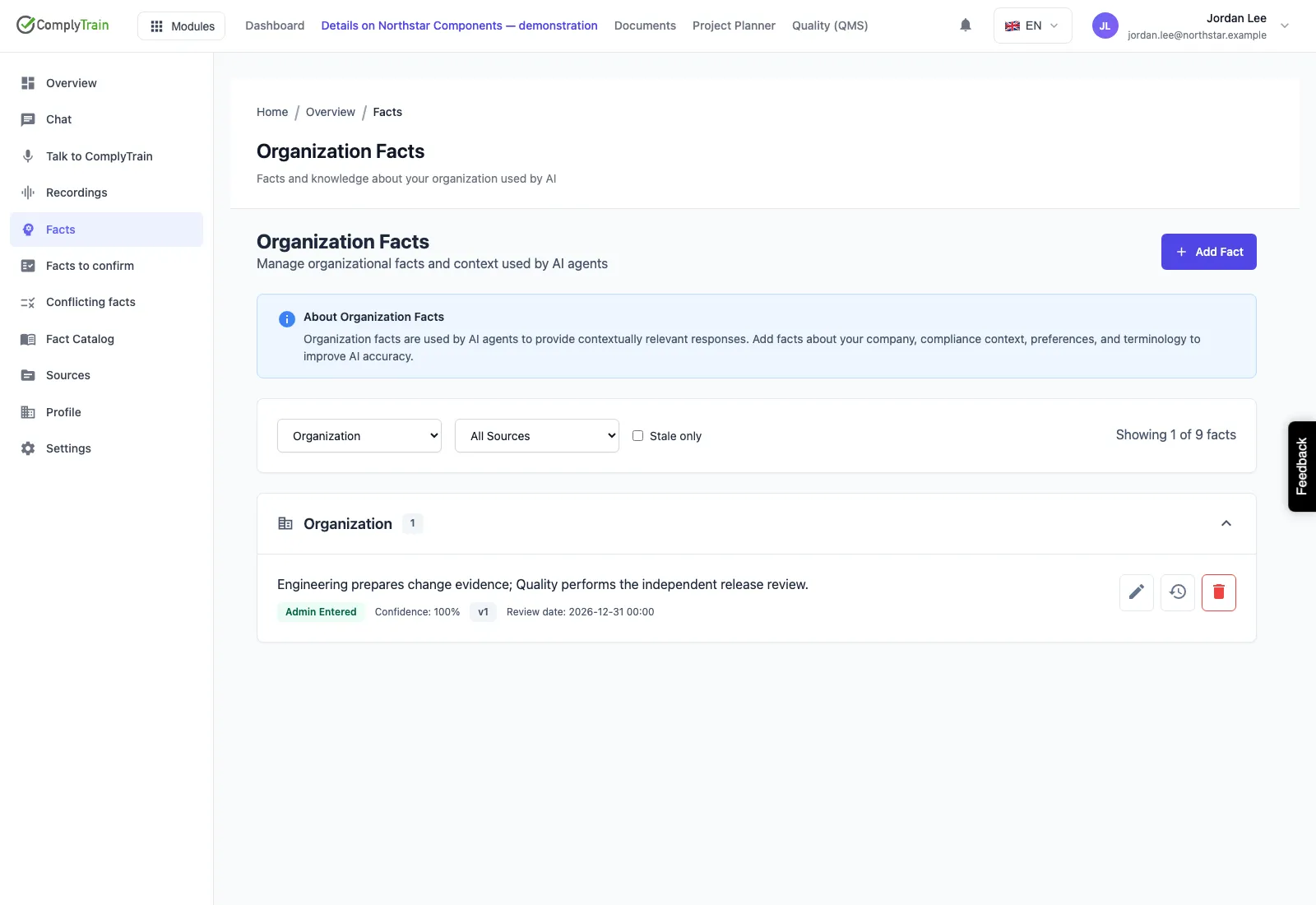
Grounded in your organisation
It answers from facts someone maintains
The agents draw on organisation knowledge: the facts about your company that keep being asked for, held once and kept current, each with its source and its history.
That is what makes an answer checkable. A reader can follow a drafted sentence back to the fact behind it and see where the fact came from and when it last changed. Proposed facts arrive for review rather than straight into use.
- Company facts held once, with source and history
- Proposed facts reviewed before anything reuses them
- Contradictions surfaced rather than silently resolved