
Training Management
Assign training, prove it was understood, and hold the competence records an auditor asks for.
Assign training by role or rule, verify understanding rather than attendance, and keep per-learner evidence an auditor can read. Completion alone is not competence, and the difference is what gets audited.
Connect training to the work people need to perform
Regulated work requires that the people doing it are trained for it, and that you can prove it. Training Management assigns the training, records what happened, and checks that the material was understood rather than merely opened.
Courses and curricula are built around real tasks, assigned to the right people by rule or by hand, and linked to the controlled document versions and roles that depend on them. Completion, a skill grant and permission to approve stay related but separate checks.
What it looks like
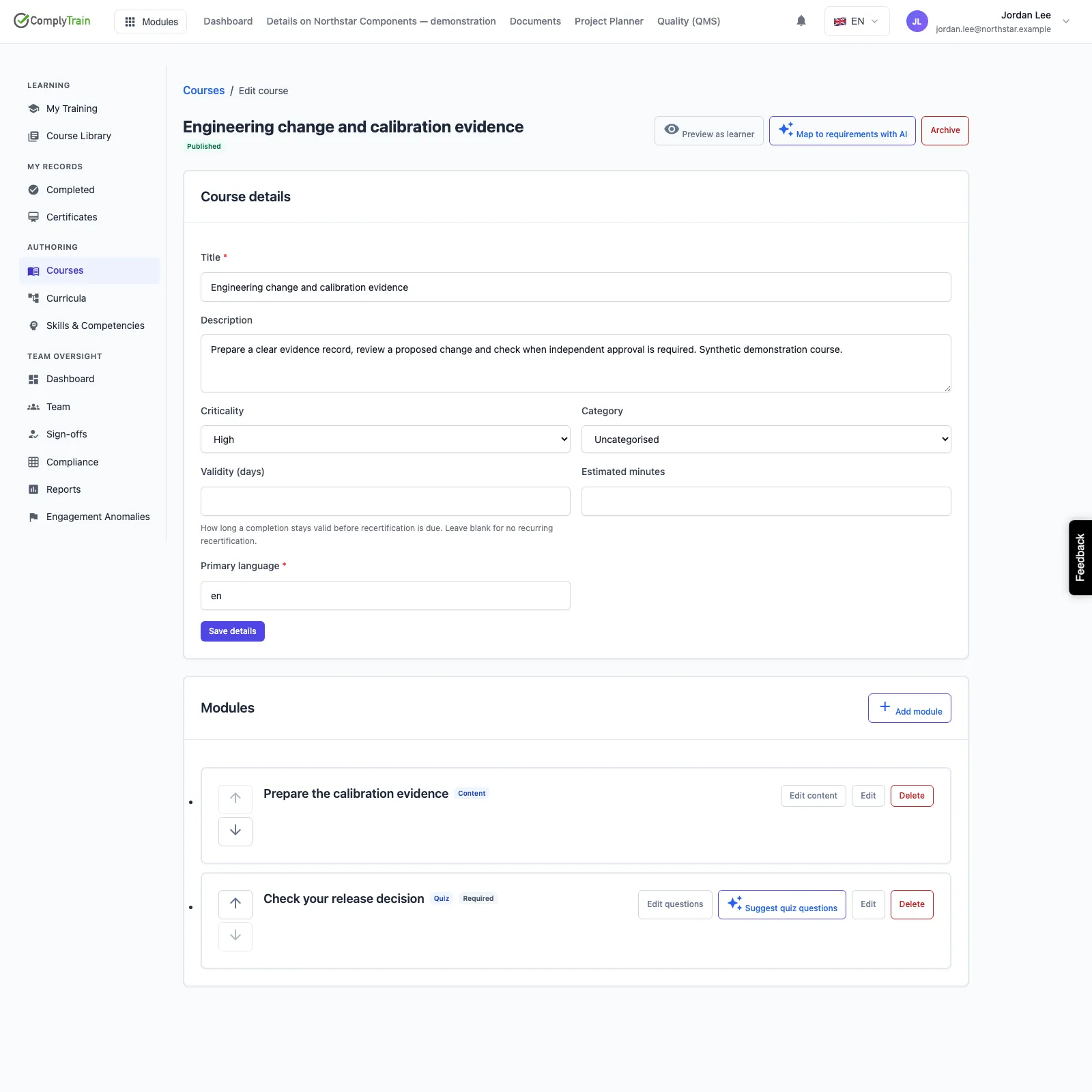
Combine instructional content and required assessments in one course. This is the published course as it was authored, not a record of anyone completing it.
Use cases
Onboarding into a regulated role
A new hire inherits the training their role requires through a rule rather than a checklist, works through it, and is signed off - with the record attached to them from day one.
Re-training on a changed procedure
A controlled procedure is revised. The affected people are assigned the change automatically, and their acknowledgement is recorded against the exact text they saw, not against the document in general.
Proving competence at audit
An auditor asks how you know a named person was competent for a task. The answer is one export: the training, the comprehension result, the practical sign-off and the dates.
Catching records that flatter you
A cohort completes a mandatory course suspiciously quickly. The pattern is flagged with a severity, a manager reviews it, and the decision - genuine concern or false positive - is recorded with a reason.
Competence you can evidence
Learning paths and competencies
Courses, modules and curricula organised into paths, with skills and competency matrices mapped to the roles that need them.
Assignments that generate themselves
Manual, rule-based, or sourced from a document revision or a recorded cause, so retraining is triggered by the event rather than by somebody remembering.
Acknowledgement against a snapshot
A document acknowledgement is tied to the content as it was, so the record proves which version of the text a person actually accepted.
Comprehension checked against a rubric
Quizzes with configurable attempts and pass marks, plus AI comprehension interviews graded server-side rather than in the learner's browser.
Engagement anomaly detection
Fast completion, short dwell, video skimming, retake gaming and repeated focus loss are flagged with a severity for a manager to acknowledge or dismiss, with a reason.
Practical sign-offs and evidence
Hands-on competence signed off by a named assessor against criteria, with per-learner evidence exportable as a PDF for auditors.
Assignment
Assign the right version to the right people
Training is assigned three ways: by hand, by rule against roles and competencies, or sourced from something that happened elsewhere in the system. A controlled procedure being revised, or a cause type recorded in risk management, can generate the retraining itself.
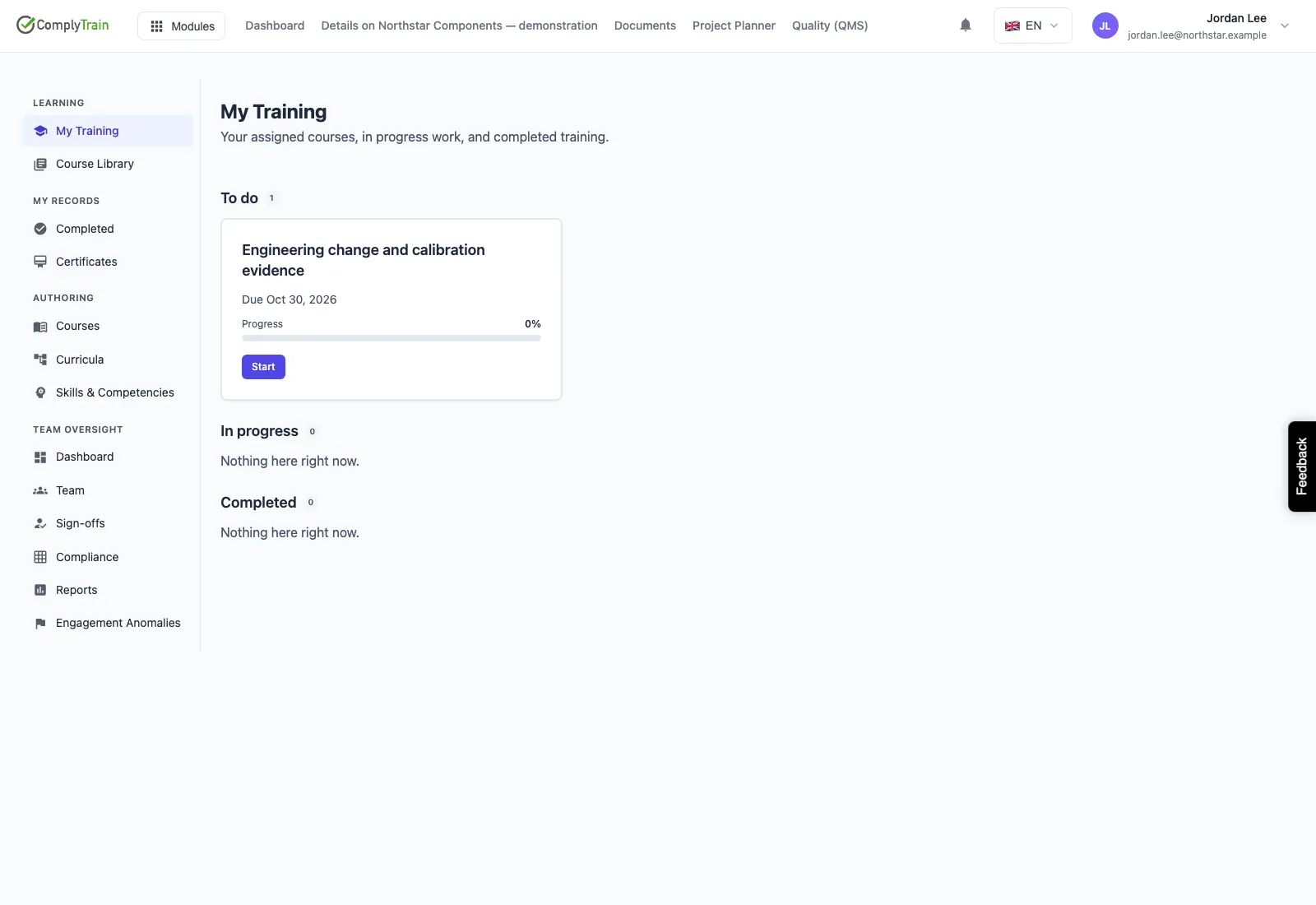
An assignment gives a learner a specific course and a due date, which is what the screen above shows. It is the start of the record rather than the end of it: completion, comprehension and any practical sign-off are separate entries, and it is those that evidence competence.
- Manual, rule-based or event-sourced assignment
- A new person in a role inherits the training that role requires
- Retraining generated from a document revision or a recorded cause
- Fixed-version references kept distinct from latest-version policies
Course content
Check understanding, not attendance
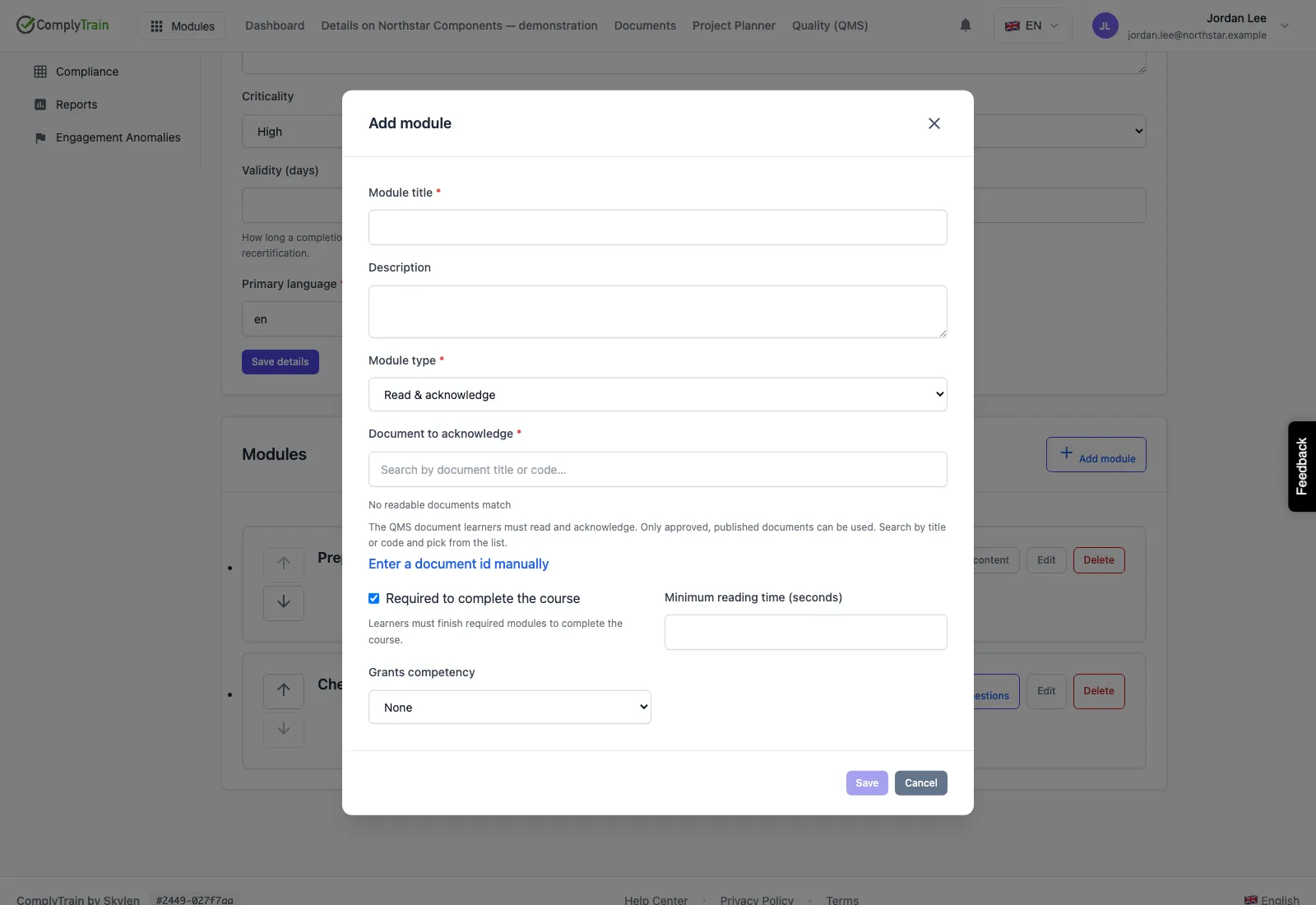
A completion tick proves someone opened a page. The module is built around the harder question of whether they understood it, because that is the one an auditor asks. Modules can be instructional content, a video with progress tracking, a quiz with an answer key and a retake policy, an AI comprehension interview graded server-side, or a read-and-acknowledge task tied to an eligible document.
Acknowledgement is tied to a content snapshot, so the record shows which text was accepted rather than which document. Some competence cannot be shown on screen at all: a practical sign-off records that a named assessor watched the work done against defined criteria.
- Read-and-acknowledge work tied to a specific eligible document
- Quizzes with answer keys and a configurable policy for attempts and retakes
- AI comprehension interviews graded server-side, not in the browser
- Practical sign-off by a named assessor against defined criteria