
Product Compliance
Know what you can offer, and hold the evidence behind every configuration you offer it in.
Keep product identity, versioned configurations, bills of materials, qualification evidence and market records connected - so a change is reviewed against what it affects before it reaches a bid or a customer commitment.
Know what you can offer, and the evidence behind it
A product has one identity and many configurations, and confusing the two is how a bid ends up promising something that was never qualified. Product Compliance keeps the identity stable and versions the configurations under it, each with its own lifecycle state.
Specifications, qualification records, bills of materials and market records hang off the configuration rather than the product, because that is the level at which a claim is either evidenced or not. A draft configuration is a real state and is not ready for a commercial commitment.
What it looks like
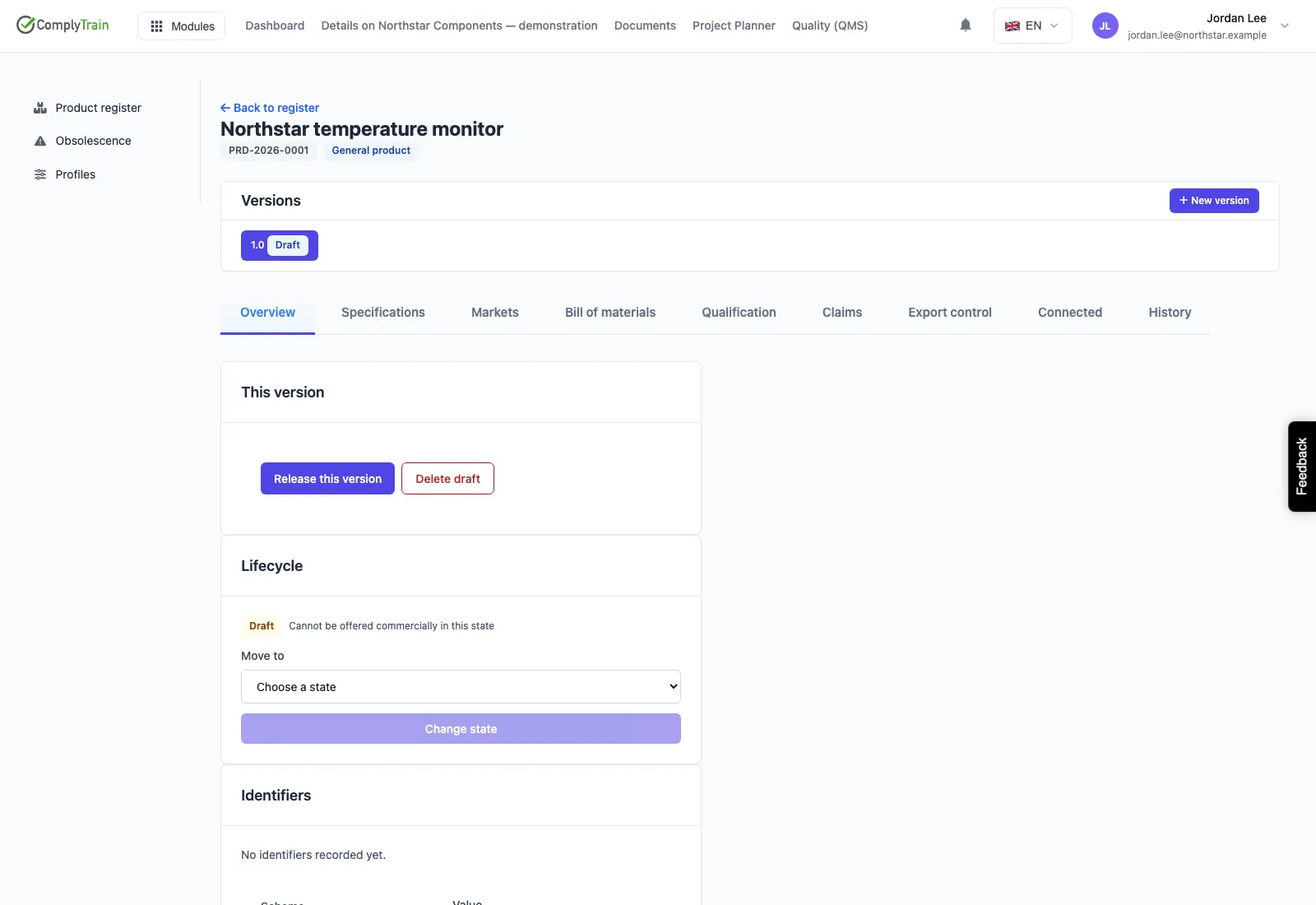
Manage a product through explicit version and lifecycle states. The configuration shown is a draft, which is a working state rather than an offerable one.
Use cases
Answer a bid without guessing
A tender asks whether a configuration meets a requirement. The answer comes from the qualification evidence held against that configuration, not from the version somebody remembers testing.
Review a change before it reaches a customer
A configuration changes. The stakeholders, requirements, training and open bids it affects are linked, so the follow-up is proposed and confirmed rather than discovered later.
Plan around an obsolete part
A component reaches end of support. The BOM shows every configuration that depends on it and the replacement plan sits on the record.
What you offer, and what you can show for it
Identity and configurations
One stable product identity with versioned configurations underneath it, each carrying its own lifecycle state.
Bill of materials
Hierarchical BOM with supplier and part identifiers, so a component question has an answer that goes deeper than one level.
Qualification evidence
Dated qualification records, waivers and claim eligibility held against the configuration they actually apply to.
Market records
Planned, placed, suspended and withdrawn markets, with the authorisation information each one requires.
Change impact
See the stakeholders, requirements, courses, watches and bids a configuration change touches, and review the follow-up before it is applied.
Obsolescence planning
Lifecycle notices, last-buy and end-of-support dates and replacement plans recorded as the maintained information they are.
Bill of materials
Trace the parts, and plan for the ones going away
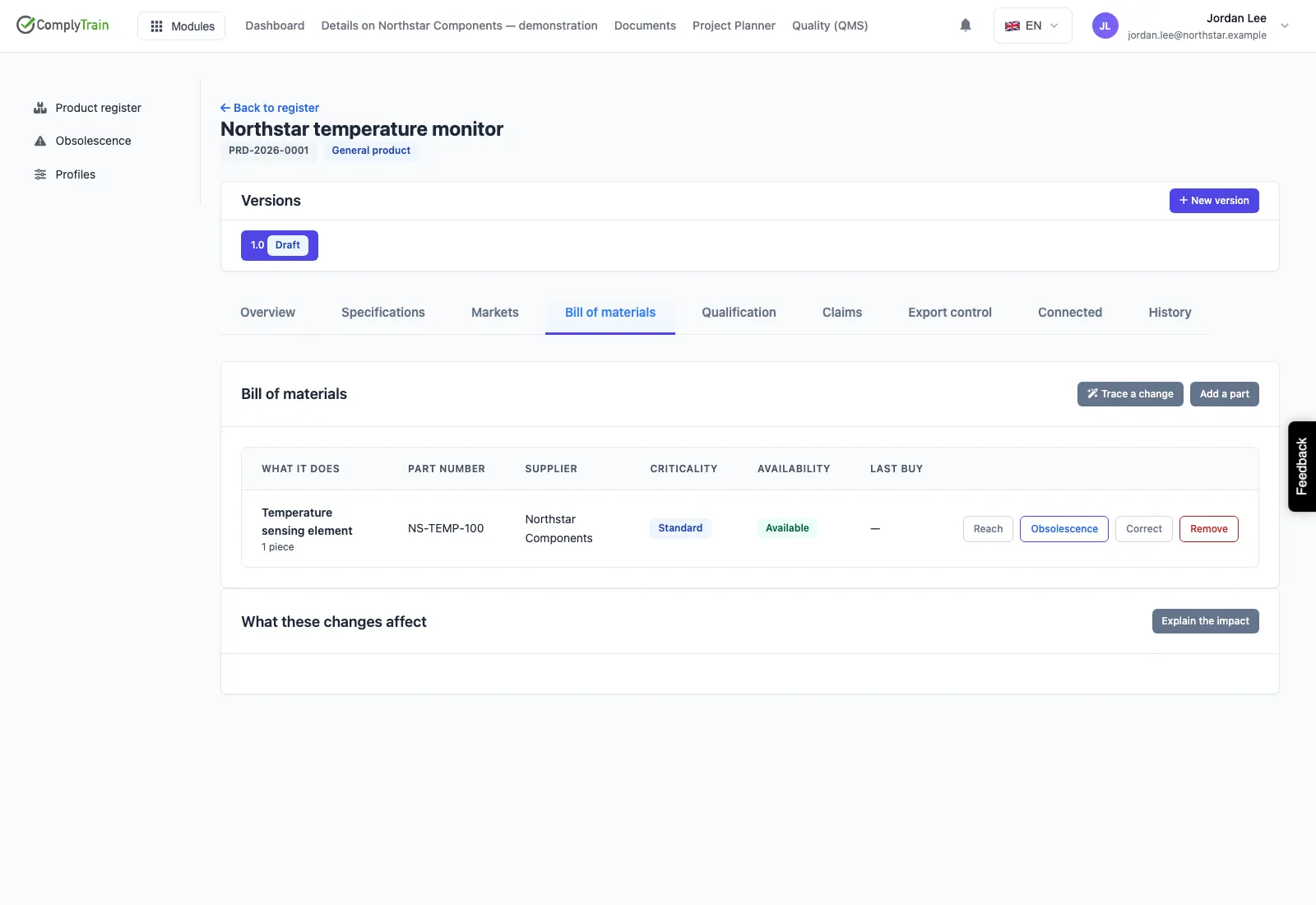
A configuration connects to the parts it depends on, with supplier and part identifiers held against each one, and the structure is hierarchical rather than a flat list. When a component is questioned - by a customer, an auditor or a supply problem - the answer does not depend on somebody's spreadsheet.
Obsolescence is recorded rather than discovered. Lifecycle notices, last-buy and end-of-support dates and replacement plans are maintained information you keep current, not an external feed that arrives on its own.
- Hierarchical BOM with supplier and part identifiers
- Market variants held against the configuration they belong to
- Last-buy, end-of-support and replacement plans recorded against the part
Markets
Understand where the product is actually offered
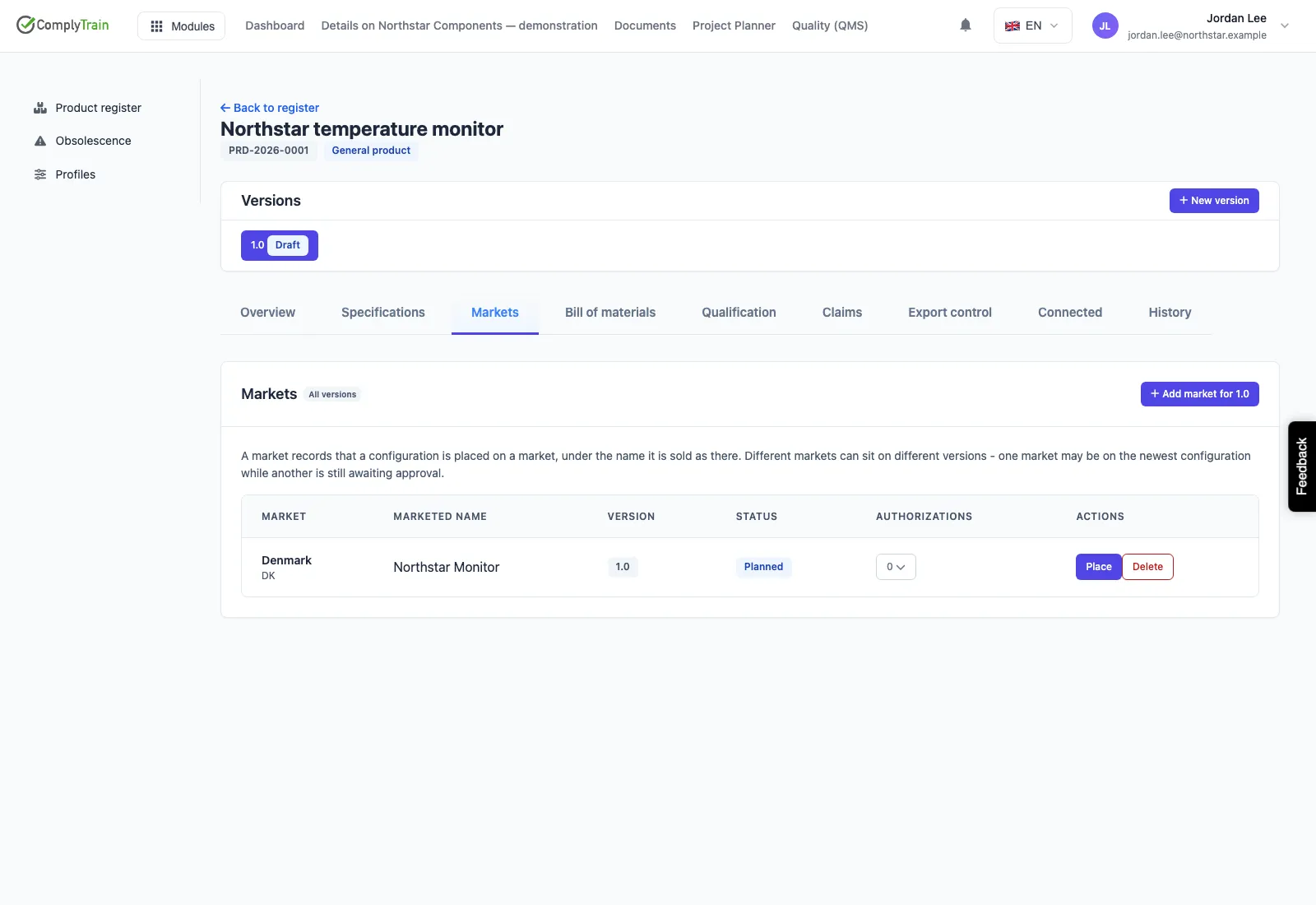
Market records track the version planned or placed in each market, and they keep the states apart: planned, placed, suspended and withdrawn are different commercial facts and each carries the authorisation information that market needs.
Export-control information is maintained evidence held against the record. It supports the decision a competent person makes; it is not an automated legal determination and should never be read as one.
- Planned, placed, suspended and withdrawn tracked separately
- Authorisation information held per market
- Export-control records kept as evidence for a human decision