
Quality management
Make management review produce decisions, not minutes
Bring the reporting period, the inputs a review has to consider and the decisions it reaches into one record, each decision with a named owner and a due date.
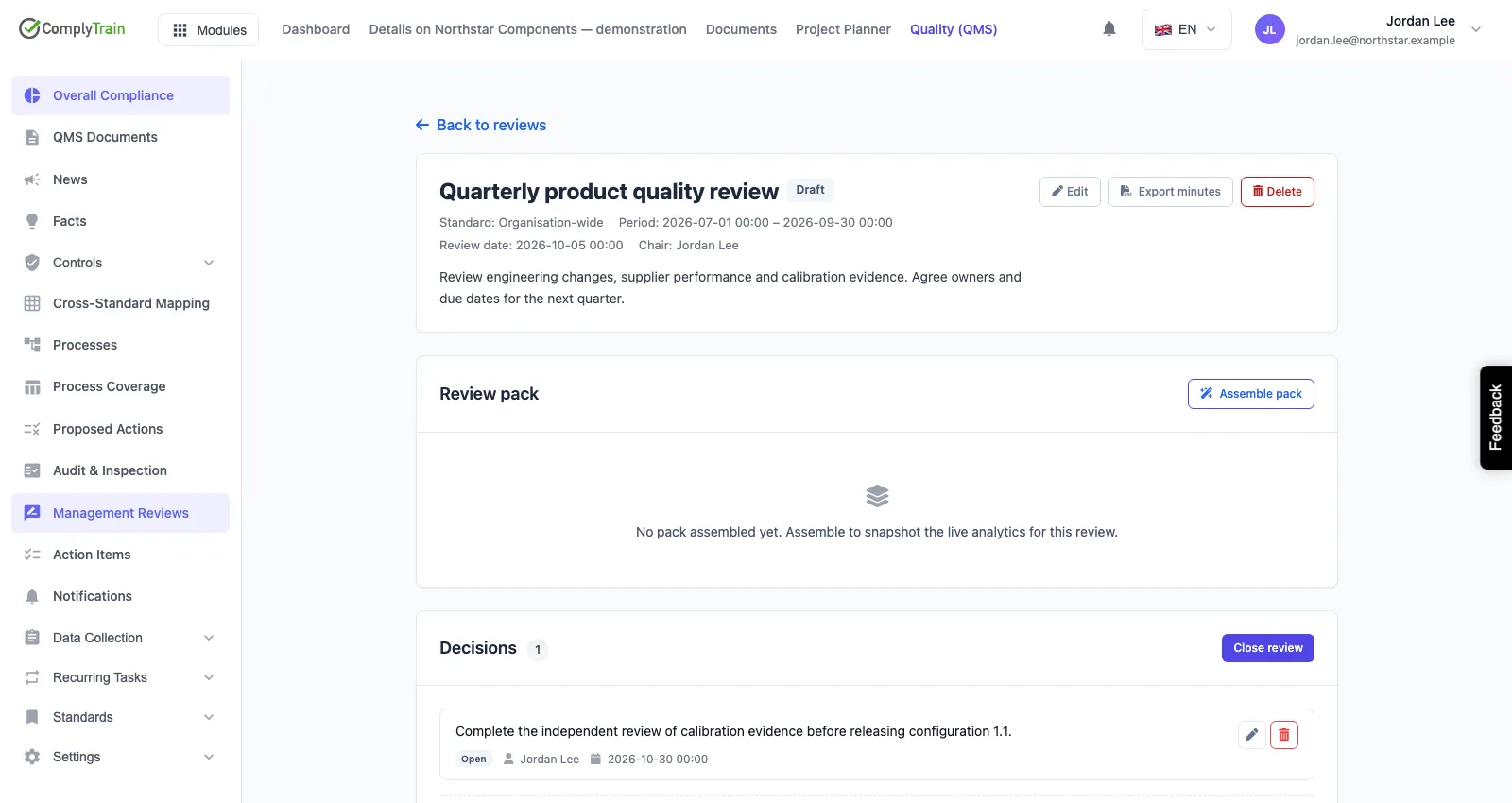
The review record
A decision with an owner and a date
A management review is organised around its reporting period and the inputs it must consider, and what comes out of it is a decision that belongs to someone and is due on a date. The review above is still a draft, which is a real business state and stays visible.
Follow-up work links out to the implementation plan, and the supporting numbers come from reporting rather than from a deck someone rebuilt the night before.
- Reporting periods with the inputs a review is expected to cover
- Decisions carry an owner and a due date
- Follow-up tracked after the meeting, not filed with it
- Inputs drawn from live records rather than re-keyed
What a review leaves behind
A defined period
Each review covers a stated reporting period, so the inputs are scoped rather than whatever was to hand.
The inputs a review must consider
The things a review has to consider are listed and marked as considered.
Owned decisions
A decision without an owner is not a decision. Each one carries a name and a date.
Numbers from the system
Supporting figures come from reporting over live records.
A durable record
The review and its decisions stay on file as the evidence that management engaged.
Into the plan
Follow-up work connects to Planner, so a decision becomes scheduled work.